






























































“ Wow, a super-cool restomod from the States. ”
Sounds awesome!
Background
Essentially a Ford Galaxie in a sharp suit, the Mercury Monterey Breezeway gained its name from the design of its rear window, which slides up and down to provide some much-needed fresh air.
You see, air-conditioning wasn’t much of a thing back then, with only 14% of buyers opting to fork out for it, so having a rear window that opens to allow a breeze must have seemed like a neat solution, especially as the reverse-rake design kept most of the rain out, especially at speed. (Snow too, according to the adverts of the period, as well as noise, smoke, sun, and wind.)
It was certainly an elegant solution but then the Mercury is an elegant car. Civilised too, thanks to the 6.4-litre/390 cubic-inch V8 that shuffles its 250bhp to the rear axle via three-speed Merc-O-Matic automatic gearbox.
Most were four-door sedans but a few, like this, had just the two doors, ratcheting up the Monterey’s elegance way past ten.
Overview
‘EBW 408B’ is a 1963 Candy Apple Red Mercury Monterey Breezeway with the two-door option that more than makes up for in grace what it might lack in practicality.
Not that it is an impractical car, and the way the front seats pivot to facilitate entry means the lack of rear doors could even be seen as a benefit because we doubt anyone will climb in without remarking on their cleverness.
The seller bought it from a good friend a couple of years ago after admiring it from afar for a long time. He’s thoroughly enjoyed owning this, his second American car, and his time with it gave him sufficient faith in its reliability to drive it to us.
Exterior
The Candy Apple Red coachwork looks sensational, doesn’t it? But then every piece of art looks better at scale, and few cars provide the same breadth of canvas as a Mercury Breezeway.
And the sheer size of the Monterey allows the colour to breath and to provide plenty of surface area for the light to bounce around; the result is sublime, especially on the roof where the intricate red and black pattern adds an unexpected moment of delight.
Of course, the air suspension allows you to slam it down when the car is stationary yet lift it to a sensible height when you want to drive it; it’s a neat arrangement that works especially well on a car of this scale, giving you a helluva stance AND compliant suspension.
The radial spoke wheels, finished in black and therefore contrasting with the red Winwood brake calipers, can therefore be nestled deep inside the wheelarches when you park. Retained by chrome spinners, both the wheels and the spinners are free of obvious flaws, but then the meaty sidewalls on the matching Nereus tyres will have helped
It’s nice to see the restomod has left the headlamps the same warm colour they’ll have been since 1963; uprated LED lights are all very well, but they do lack the charm and romance of the originals.
Of course, the lamp lenses are all in great shape with no chips, cracks, or other damage to ruin their performance or looks.
Speaking of looks, the chromework, of which there is a good couple of acres, is in good shape being largely free of rust and heavy pitting (we’ll come to the rear bumper in a moment).
The glazing is in good shape too, and it’s retained with fresh-looking rubber seals. The long doors also pop open at the press of a button, adding yet another dimension of cool to a car that’s already way past sub-zero.
As for flaws, a blemish has been touched-up on the offside rear wing, there are marks at the rear of the bonnet, the chrome trim on the nearside rear wing is dinked, the offside corner of the front bumper has a couple of small dents, and the rear bumper is starting to rust around the numberplate and on its underside.
There are also swirls, fine scratches, and minor marks across the coachwork, although a lot of them could probably be machine-polished out.
Rust is also starting on the top of both A-pillars, along the top of the windscreen, at the trailing edge of the offside rear window, and at the base of the offside front wing, and sorting this out should probably be a priority.
The paint finish to the two edges of the roof isn’t up to the same standard as the coachwork either, but it’s not a huge difference and besides, no colour is more unforgiving than black.
Interior
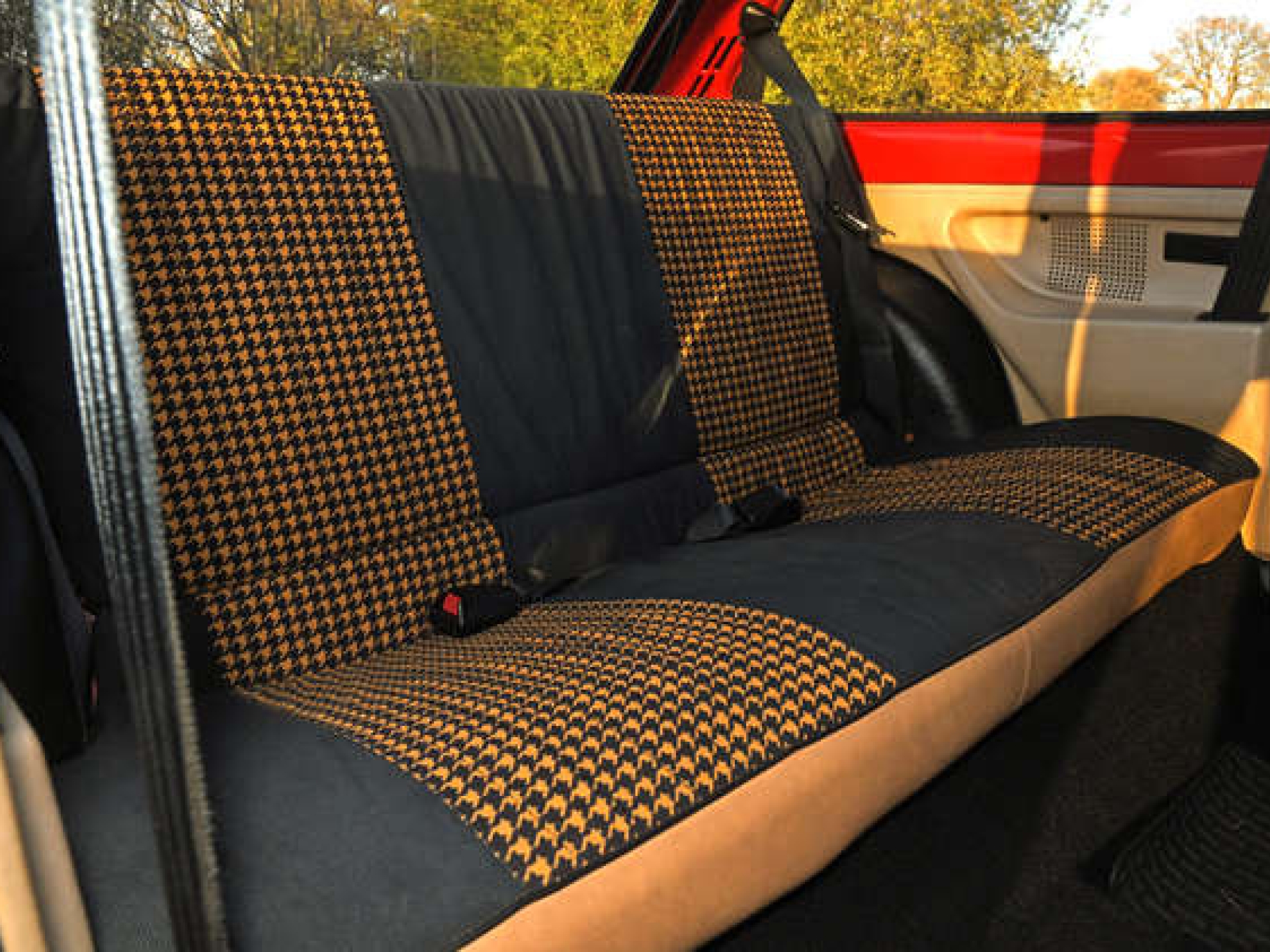
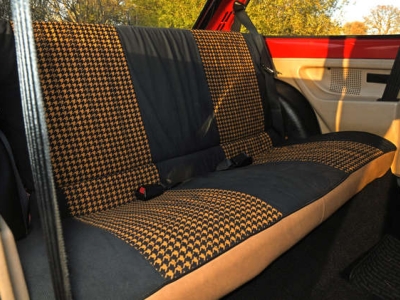
The backrests fold independently to give access to the huge rear bench seat, but the base of the front seat in one piece, allowing your passenger to snuggle up close when you’re watching a movie at the drive-in.
Like the roof, it’s a clever solution and works in real life every bit as well as it does on paper.
The seats are in great shape too, with no significant wear or damage to their face material, and still-firm springing underneath.
The driver also gains access to a beautifully fabricated alloy steering wheel. Fitted in 2014, it’s even lovelier to handle than it is to look at: Art and engineering has never looked better.
The radio is almost certainly the original, and its presence, along with some gorgeously patinated Art Deco-influenced instruments and warm interior lighting, make this a very special place to be.
Carpets and door cards are in great shape too, with nothing other than the expected light wear to their surfaces. Mind you, the latter were remade in 2015, so they’re only ten years old.
In line with its carefully-judged restomod status, a Sunpro Super Tach II is fitted by the driver’s left knee, extra speakers have been fitted front and rear, and the air suspension is adjusted by a Fancy Pants remote control from Airlift Performance.
The boot contains two air tanks and two matching Viair compressors; again, everything seems to have been done with efficiency and reliability in mind. It’s been very neatly installed too, with suitably strong brackets, neatly run lines, and symmetrical placement.
As for flaws, a tear in the headlining has been repaired, it is missing a couple of the window winder handles, some wires have been snipped in the boot, and the rear seat has a scuff in the middle of its backrest.
The door-mounted Kicker speakers could have been more neatly installed too, but that’s very much a second-order concern.
Mechanical
The invoices on file show the following work:
22.12.2009 – miscellaneous restoration work by Valley Gas Speed Shop at a cost of £1,138
30.01.2010 – various fettling by Valley Gas Speed Shop at a cost of £1,434
01.04.2010 – various engine and cooling system work by Valley Gas Speed Shop
28.05.2010 – miscellaneous work by Valley Gas Speed Shop including fitting electronic ignition, changing the tyres, freeing off the brakes, servicing the engine, gearbox, and ignition system, change exhaust manifolds, fit interior trim, roll the wheelarches, and much more at a cost of more than £2,000
01.07.2010 – engine top-end and ignition work by Valley Gas Speed Shop at a cost of £833
01.09.2010 – engine rebuild by Valley Gas Speed Shop at a cost of around £2,600 including machining
01.12.2010 – post-work checks by Valley Gas Speed Shop at a cost of £475
01.03.2011 – rebuilding the transmission, new suspension dampers and more by Valley Gas Speed Shop at a cost of almost £2,000
The Mercury maintains the reputation American cars of this era have for being massively over-engineered; built like a tank using girders Brunel would have rejected for being too hefty, while its last MoT might have been in 2017 you’ll search in vain for any mention of structural corrosion among the tester’s comments.
The paint on the sills isn’t fresh, which is good news, and it isn’t bubbling either, which is even better.
The airbags for the suspension still look like new and there are fresh clips aplenty; someone’s taken the time to do things properly, even in the sort of places where few people would bother to peer. The seller is trying to find the invoice for the work, but it assures us it was a five-figure sum, which we have no trouble believing having seen the quality of the parts and installation.
As for work to do, you’ll need to wire-brush and paint the fuel tank, wheelarches, and chassis rails but this is protective work rather than remedial, and that sort of job’s more of a pleasure than a pain, right?
The tie-rod ends have perished too, and while you’ve got the spanners out, you could sort out the boot release mechanism, which is currently operated by a length of wire and a washer.
We suspect the new owner will want to freshen up the engine bay at some point because it isn’t up to the same standard as the rest of the car.
The high-spec Optima battery helps the big V8 burst into life while a beautifully fabricated alloy radiator helps keep things cool.
History
The Mercury doesn’t have a current MoT certificate, and while it is exempt by virtue of its age, we would strongly encourage the new owner to have it MoT’d at the earliest opportunity. The cost of an MoT is a small investment when offset against the purchase and upkeep of any classic vehicle, and it gives an independent, third-party assessment of the car’s condition, which not only provides reassurance to the owner (and any subsequent purchasers) but might also be invaluable in the event of a bump when negotiating with the police and any interested insurance companies…
The recent Vehicle History Check is clear bar the marker for being an imported car, and there is a bundle of invoices for work by Valley Gas Speed Shop between 2009 and 2011.
Summary
With the hard work done, a few small jobs remain but these are things you will want to do to ensure you can enjoy your Mercury Breezeway for another 60 years, rather than urgent problems you’ll need to get ahead of before the start of next show season.
And few cars offer more on a pound-per-pound basis than 60’s American barges, and this one looks every bit as good as it drives; throw in the five-figure air suspension conversion and we suspect our guide price of between £18,000 and £23,000 offers more value than anything you’ve seen in 2026 so far.
Viewing is strongly encouraged, and this lot is located at THE MARKET HQ in South Oxfordshire. Viewings are STRICTLY BY APPOINTMENT and we are open weekdays (apart from Bank Holidays) between 10am - 12pm or 2pm - 4pm. To make a booking, please use the ‘Enquire About This Vehicle’ button on the listing. Feel free to ask any questions, or try our ‘Frequently Asked Questions’.
Contact Us
